

20 MPH Fixed Bollard – Carbon / Powder Coated [RFP 8660R S20]
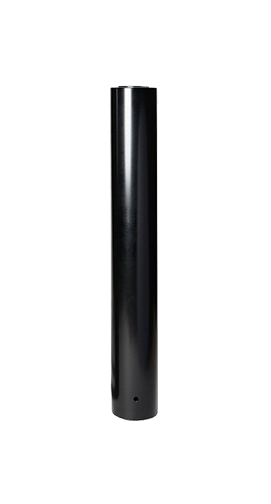
Specifications
| Height | 36" |
|---|---|
| Meta Title | 20 MPH Fixed Bollard – Carbon / Powder Coated [RFP8860R S20] |
| Crash Rating (mph) | 20 MPH |
| Size | 8.625" OD |
| Material | Carbon Steel / Powder Coated |
| Installation Type | Standard |
| Cap Options | Flat (shown) or round |
TrafficGuard ® carbon steel fixed bollards rated for 20 mph impacts under ASTM F3016 are rigorously tested to ensure they can protect pedestrian areas and infrastructure in low-speed environments. The ASTM F3016 standard, developed for low-speed crash barriers, outlines a precise testing protocol to verify a bollard’s ability to stop or significantly slow a 5,000-pound vehicle, such as a pickup truck, traveling at 20 mph.
Testing begins with the bollard installed in a concrete foundation, replicating real-world conditions. The test vehicle is propelled at 20 mph toward the bollard, striking it head-on. The impact is monitored using high-speed cameras, sensors, and data acquisition systems to measure key parameters: the bollard’s structural integrity, deformation, and ability to prevent vehicle penetration. For a bollard to pass, it must remain functional, with minimal damage that does not compromise its protective capability. The vehicle’s stopping distance and damage are also assessed to ensure the bollard effectively absorbs and dissipates the impact energy.
Carbon steel, often coated with galvanization or powder-coating to resist corrosion, is chosen for its high tensile strength, making it ideal for absorbing the kinetic energy of a 20 mph collision. Finite element analysis may complement physical testing, simulating stress points to optimize design before crash tests, but is not a substitute for a crash test. Multiple tests may be conducted to account for variations in soil conditions or installation methods.
Successful ASTM F3016 certification confirms the bollard’s reliability in settings like parking lots or urban plazas. These tests provide stakeholders with confidence in the bollard’s performance, ensuring safety and compliance with federal or local regulations for protective barriers.